
At the heart of criminal law lies a deceptively simple question: when does conduct become a crime? The answer is neither intuitive nor moral alone. In a constitutional system governed by the rule of law, conduct becomes criminal only when it satisfies the legal definition of an “offence” as laid down by statute.
The Bharatiya Nyaya Sanhita (BNS) begins its substantive framework by defining what the State considers punishable behaviour. This definition is foundational. Every arrest, prosecution, trial, and conviction under the new criminal law rests on whether an act or omission qualifies as an “offence” under the BNS.
Understanding this concept is therefore essential not only for lawyers and judges, but also for citizens seeking to understand how criminal liability is created, limited, and enforced.
Statutory Definition of an Offence
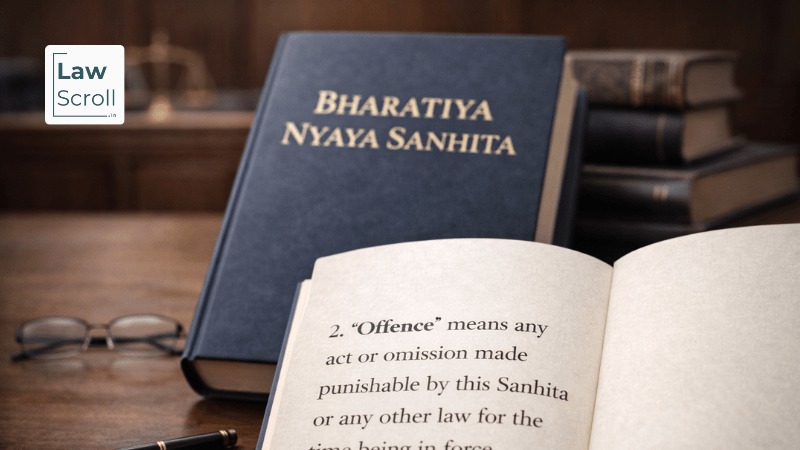
Section 2 of the Bharatiya Nyaya Sanhita defines an “offence” as any act or omission made punishable by the Sanhita or by any other law for the time being in force. This definition is concise but far-reaching.
Two key elements flow from this statutory formulation. First, criminal liability arises only from law, not from morality, public outrage, or administrative convenience. Second, an offence may arise not only from positive conduct but also from a failure to act, where the law imposes a legal duty.
This definition mirrors a long-settled principle of criminal jurisprudence: nullum crimen sine lege — there can be no crime without law. The Constitution reinforces this through Article 20(1), which prohibits punishment for acts that were not offences at the time of commission.
Act and Omission: The Two Forms of Criminal Conduct
The BNS, like its predecessor, recognises that criminality may arise in two ways: through an act or through an omission.
An act refers to voluntary human conduct. Theft, assault, cheating, or falsification of documents are classic examples where liability flows from what a person does.
An omission, on the other hand, refers to a failure to act where the law imposes a duty. Not every failure is criminal. The omission must be legally blameworthy. For instance, a parent’s failure to provide food to a dependent child, or a public servant’s failure to perform a statutory duty, may attract criminal liability because the law creates a specific obligation.
Courts have consistently held that criminal omissions require a clear legal duty. In Kishori Lal v. State of Rajasthan, the Supreme Court observed that omission becomes criminal only when there is a legal obligation to act, not merely a moral expectation.
Punishability as the Core Test
Not every wrongful act is an offence. Civil wrongs, contractual breaches, and regulatory violations may attract penalties without being crimes. What distinguishes an offence under the BNS is punishability.
An act or omission becomes an offence only when the Sanhita or another law prescribes punishment for it. This ensures legal certainty and protects citizens from arbitrary criminalisation.
Section 3 of the BNS reinforces this framework by clarifying that offences under other laws remain punishable unless specifically excluded. This allows special statutes — such as anti-corruption, narcotics, or information technology laws — to coexist with the BNS.
Mental Element: Intention, Knowledge, Recklessness and Negligence
Criminal law does not punish mere accidents. A central requirement of an offence is the presence of a culpable mental state, unless the statute expressly provides otherwise.
The BNS, through its general provisions and offence-specific sections, recognises varying mental states such as intention, knowledge, recklessness, and negligence. The degree of mental culpability determines both criminal liability and the severity of punishment.
For example, causing death with intention or knowledge is treated as a graver offence than causing death by negligence. This distinction reflects the principle that blameworthiness depends not only on the outcome but also on the state of mind.
In State of Maharashtra v. Mohd. Yakub, the Supreme Court held that intention is a question of fact to be inferred from circumstances, conduct, and surrounding facts, rather than direct evidence.
Voluntariness and Control
An essential but often overlooked component of an offence is voluntariness. Criminal liability generally presupposes that the accused had control over their actions.
Acts done under compulsion, unconsciousness, or physical incapacity may fall outside criminal liability, a principle recognised through general exceptions in the BNS. This aligns with the broader maxim actus non facit reum nisi mens sit rea — the act does not make a person guilty unless the mind is also guilty.
Courts have used this principle to exclude liability where conduct was involuntary, such as acts committed during sleepwalking or medical emergencies, provided statutory conditions are satisfied.
Offences Created by the BNS: Structure and Scheme
The BNS organises offences thematically, reflecting both the nature of harm and the protected interest. Crimes against the State, public order, the human body, women and children, property, and justice itself are grouped into distinct chapters.
Each offence provision typically contains:
- The prohibited conduct
- The required mental element
- The prescribed punishment
For instance, provisions dealing with theft specify dishonest intention, movement of movable property, and lack of consent, followed by the punishment clause. This structure ensures that liability is not imposed unless every ingredient is satisfied.
In State of Haryana v. Bhajan Lal, the Supreme Court emphasised that criminal prosecution cannot proceed unless the ingredients of the offence are prima facie made out.
Continuing Offences and Composite Liability
Some offences under the BNS are continuing offences, where liability persists so long as the unlawful state of affairs continues. Others involve composite acts, where multiple actions together constitute a single offence.
This distinction matters for limitation, jurisdiction, and sentencing. Courts examine the nature of the offence to determine whether fresh liability arises each day or whether the offence is complete once the act is done.
Strict Liability Offences
While criminal law traditionally requires mens rea, certain offences under special statutes impose strict liability, where proof of intention is not necessary. The BNS itself generally adheres to fault-based liability, but it accommodates statutory exceptions created by other laws.
The Supreme Court, in Hariprasad Rao v. State, clarified that strict liability must be expressly or clearly implied by statute and cannot be presumed.
Attempt, Abetment and Conspiracy
The concept of offence under the BNS extends beyond completed acts. Attempt, abetment, and criminal conspiracy are punishable because the law seeks to intervene before harm fully materialises.
By criminalising preparatory and participatory conduct, the BNS acknowledges that societal harm often begins long before the final act is committed.
This reflects the preventive dimension of criminal law, recognised in State v. Nalini, where the Supreme Court examined how collective planning and facilitation attract liability independent of the final outcome.
Constitutional Safeguards Against Overcriminalisation
The breadth of the offence definition is balanced by constitutional safeguards. Article 14 ensures equality before law, preventing arbitrary classification of conduct as criminal. Article 21 demands fairness, reasonableness, and due process.
Courts have repeatedly cautioned against overcriminalisation. In Shreya Singhal v. Union of India, vague and overbroad criminal provisions were struck down for chilling free speech, reaffirming that offences must be clearly defined and narrowly tailored.
Why the Definition of Offence Matters
Understanding what constitutes an offence under the BNS is not a technical exercise. It determines:
- Whether police can register an FIR
- Whether arrest is lawful
- Whether prosecution can be sustained
- Whether punishment can be imposed
For citizens, this knowledge acts as a shield against arbitrary State action. For institutions, it provides a disciplined framework for enforcing criminal law.
Conclusion
An offence under the Bharatiya Nyaya Sanhita is not merely wrongdoing. It is legally defined, constitutionally constrained, and judicially interpreted conduct that attracts punishment by the State.
By anchoring criminal liability in statute, mental culpability, and due process, the BNS continues India’s commitment to a rule-based criminal justice system. Understanding this concept is the first step in understanding how crime, procedure, and proof interact in modern Indian criminal law.


