
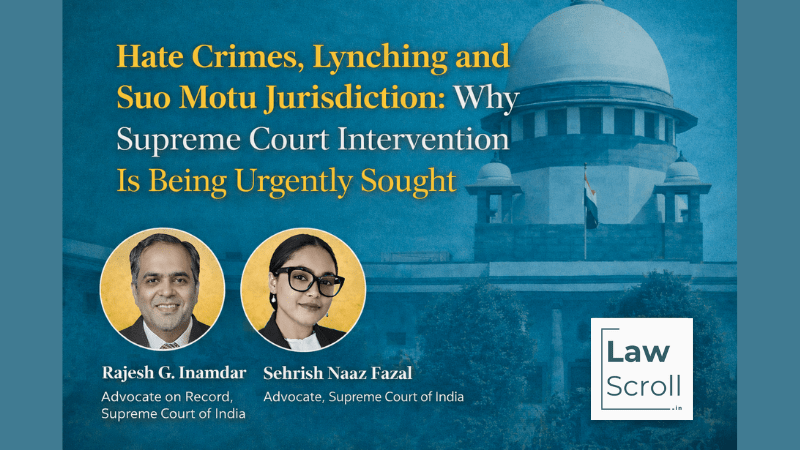
While the Supreme Court of India has, on numerous occasions, demonstrated commendable constitutional sensitivity by taking suo motu cognisance of issues such as stray dog attacks, road safety, environmental degradation, prison conditions, digital arrest scams, and non-functional CCTV cameras in police stations, an equally if not more urgent constitutional crisis continues to demand its immediate and sustained attention: the alarming rise of hate crimes, mob lynching, targeted communal violence, and discriminatory policing. Since 1990, the Court has initiated several suo motu proceedings, with a marked increase in recent years, reflecting its evolving role as a constitutional sentinel responding to systemic failures and threats to governance. However, despite its proactive posture in matters of public safety and administrative concern, there remains a conspicuous absence of comparable institutional urgency in addressing the escalating pattern of identity-based violence.
In recent times, the Court has taken suo motu cognisance of matters such as stray dog attacks, directing civic authorities to formulate policy measures for sterilisation, vaccination, and public safety, particularly in sensitive public spaces, including hospitals, schools, railway stations, and bus depots. In 2025 alone, the Court initiated proceedings concerning digital arrest scams, environmental degradation, non-functional CCTV cameras in police stations, and the stray dog menace, underscoring its proactive and interventionist posture.
The distinction between general public safety concerns and hate crimes is both stark and constitutionally significant.
When stray dogs attack, they do not discriminate based on caste, colour, religion, gender, or identity; their actions, though tragic, are indiscriminate and apolitical.
Hate crimes, by contrast, are deliberate, targeted, and ideologically driven. They are directed against specific communities, particularly minorities such as Muslims and Christians, and can no longer be dismissed as isolated aberrations. The repeated incidents of violence and intimidation reflect a disturbing national pattern that strikes at the foundational principles of equality, fraternity, secularism, and the rule of law enshrined in the Constitution.
Hate crimes and lynching are not mere law-and-order issues; they represent a direct assault on the constitutional promise of equal protection, the dignity of the individual, and the secular character of the Republic. Unlike administrative lapses or environmental concerns, identity-based violence corrodes social cohesion and democratic stability at its core. In such circumstances, constitutional morality and the preservation of the rule of law warrant the highest degree of judicial vigilance and, where necessary, decisive constitutional intervention.
Hate Crimes: A Deeper Constitutional Emergency
Public safety issues such as stray dog attacks undoubtedly merit judicial concern, given their impact on human life and public health. However, hate crimes and communal lynching represent a far deeper constitutional emergency. These crimes do not merely endanger individual safety. They corrode the moral and constitutional fabric of the Republic.
Unlike accidental or environmental dangers, hate crimes are ideologically motivated acts of violence, often legitimised through social prejudice and institutional apathy. They create a climate of fear, exclusion, and permanent vulnerability for entire communities, consequences far more enduring than physical injury alone.
When violence is targeted against individuals solely on account of their religion, belief, identity, or cultural expression, the attack is not merely on a person. It is an assault on constitutional citizenship itself.
A Disturbing Pattern of Vigilantism and Selective Policing
Recent incidents reported across multiple states reveal a deeply troubling pattern. Private vigilante groups allegedly indulge in acts of assault, vandalism, intimidation, and public humiliation, often in the name of religious or cultural enforcement, while law enforcement agencies either remain passive spectators or, worse, proceed against the victims themselves.
- A striking example is the widely reported incident from 27.12.2025 in Bareilly, Uttar Pradesh, where a group of vigilantes allegedly stormed a café and assaulted guests at a birthday celebration attended by students of multiple faiths, including two Muslim youths, and later two of the Muslim attendees were initially booked by police for “breach of peace”. Videos of the assault circulated widely on social media and in news outlets, showing the attackers objecting to the presence of Muslim students and levelling claims of “love jihad”, despite the gathering being a private celebration among consenting friends. Following significant public backlash, the police registered an FIR against the men who disrupted the party, while questions were raised about the initial police response and the criminalisation of inter-community interaction, raising grave concerns about disproportionate and biased law enforcement.
- Similarly, multiple incidents during Christmas celebrations saw alleged attacks on members of the Christian community, including vandalism of shopping malls and intimidation at public spaces decorated for festivities. These acts directly infringe Article 25, which guarantees freedom of conscience and the right to freely profess, practice, and propagate religion.
- A disturbing incident was reported from Kotdwar in the Pauri Garhwal district of Uttarakhand, where a group of men allegedly confronted a 70-year-old Muslim shopkeeper over the name of his garment shop on communal grounds. At that stage, Mr. Deepak and his friend Mr. Rawal intervened to oppose the intimidation and to protect the elderly shopkeeper, an act that reflected social harmony and inter-community brotherhood. However, FIRs were thereafter registered, protests ensued, and threats were reportedly issued against them and their families. Subsequently, hundreds of members of a Hindu organisation allegedly entered the city, creating a serious law-and-order situation, and gathered outside the residence of Mr. Deepak, raising slogans and issuing threats. The incident underscores how ordinary disputes are increasingly communalised, leading to public order concerns and biased legal responses.
- What is even more disturbing is that individuals occupying high constitutional and public offices have, on occasion, made public statements that appear to single out particular communities in a manner inconsistent with the spirit of constitutional governance.
For instance,
- The head of the executive in a north-eastern State has, in public speeches and official communications, repeatedly used terminology such as “Miya” in a pejorative and politically charged context while referring to Bengali-origin Muslims, a term that has been widely criticised as stigmatizing and communal. On multiple occasions, statements linking demographic change, land encroachment, and criminality to a particular religious community have drawn national attention and allegations of inflammatory rhetoric.
- Similarly, a serving cabinet-rank political functionary in the Government of Maharashtra and a sitting Member of the Maharashtra Legislative Assembly has, on several occasions, publicly made remarks directed against the Muslim community that have been widely perceived as derogatory and inflammatory in nature. Despite the public circulation of such speeches and the controversy they generated, no meaningful or proportionate legal action appears to have been taken, giving rise to concerns regarding selective enforcement and the apparent inaction of the law-enforcement machinery.
- Such statements, emanating from constitutional authorities and public servants sworn to uphold the Constitution, carry far greater institutional weight than ordinary political rhetoric. When accompanied by visible inaction or silence on the part of law-enforcement agencies, they risk creating a perception of selective enforcement and eroding public confidence in the neutrality of the State. In a constitutional democracy founded upon equality before the law and secular governance, the expectation from holders of high office is not merely restraint, but an affirmative commitment to protect every community without fear or favour.
These are only a few illustrative instances. There are several such incidents across the country where groups of individuals have, at various times, sought to violently impose their ideological beliefs upon members of minority communities.
Lynching and Hate Crimes: From Anomaly to Normalisation
These incidents are not aberrations. They reveal a systemic normalisation of hate-based violence, where mob justice increasingly substitutes constitutional governance.
What is particularly alarming is the pattern of selective policing, wherein victims are arrested to defuse public pressure, FIRs are diluted or delayed against perpetrators, counter-cases are registered to create artificial parity, and investigations remain sluggish and inconclusive.
This trend erodes public trust in law enforcement and sends a dangerous signal that constitutional protections are contingent on identity.
Indian Legal Framework on Hate Crimes
In India, there is no single consolidated “hate crime law”, but a network of constitutional provisions, penal statutes, and judicial safeguards that together form the legal framework addressing hate speech, hate crimes, and communal violence.
Global Perspective: How Other Democracies Respond to Hate Crimes
Across constitutional democracies, hate crimes are treated not merely as criminal acts but as assaults on democratic values themselves.
In the United States, repeated incidents of racially motivated violence culminated in 2020 with the killing of George Floyd, which became a watershed moment, triggering nationwide protests, heightened judicial scrutiny, and significant legislative and police accountability reforms. The incident galvanised the Black Lives Matter movement and exposed systemic racial bias in law enforcement and criminal justice. American courts have consistently recognised that hate crimes are not ordinary offences but aggravated acts warranting enhanced punishment and heightened judicial sensitivity, given their broader impact on equality, dignity, and social order.
Similarly, in Germany, shaped by its historical experience, hate speech and hate crimes are addressed with strict statutory and constitutional safeguards. The German Criminal Code (Strafgesetzbuch – StGB) criminalises the dissemination and use of unconstitutional and Nazi symbols under Sections 86 and 86a, and penalises racial incitement and attacks on human dignity through Section 130 (Volksverhetzung), which prohibits incitement to hatred, calls for violence, or assaults on the dignity of national, racial, religious, or ethnic groups. These provisions are reinforced by the Basic Law for the Federal Republic of Germany (Grundgesetz), particularly Article 1, which declares human dignity to be inviolable, and Article 3, which guarantees equality and prohibits discrimination. German courts actively enforce these provisions, reflecting a constitutional commitment to zero tolerance for hate-based conduct and the protection of pluralism, dignity, and social harmony.
In the United Kingdom, hate crimes are governed by a specialised statutory framework. The Crime and Disorder Act, 1998, under Sections 29 to 32, creates distinct offences where criminal conduct is racially or religiously aggravated, prescribing enhanced punishment when hostility based on race or religion is demonstrated or motivates the offence. An offence is treated as aggravated if the offender demonstrates or is motivated by hostility towards the victim because of race or religion. Complementing this, the Public Order Act, 1986, particularly Part III (Sections 17–23) and Part IIIA (Sections 29A–29G), criminalises threatening conduct and speech intended to stir up racial or religious hatred. This covers speech, behaviour, performances, publications, broadcasts, etc., that are intended to stir up hatred. Further, Sections 145 and 146 of the Criminal Justice Act, 2003 mandate courts to treat hostility based on race, religion, sexual orientation, disability, or transgender identity as an aggravating factor at the sentencing stage, thereby requiring enhanced punishment. Collectively, these enactments recognise hate motivation as a legally significant factor warranting heightened criminal liability and judicial sensitivity due to the broader societal harm caused by such offences.
These global examples underscore a common democratic principle: hate crimes demand exceptional constitutional and judicial attention because they threaten societal cohesion itself. India, as the world’s largest constitutional democracy, cannot afford a weaker response.
Supreme Court’s Constitutional Duty: Why Suo Motu Action is Imperative
The Supreme Court, as the sentinel on the qui vive, bears a special constitutional obligation to protect fundamental rights when institutional failure becomes apparent.
Article 21 is the living spirit of the Constitution, which includes: Right to life, Right to dignity, Right to live without fear and Right to personal security. It finds its true strength when citizens perform their Fundamental Duties in daily life. Hate crimes are the most extreme form of discrimination, where bias translates into: Physical violence; Social exclusion and Public humiliation. Thus, hate crimes represent private discrimination with public consequences, triggering State responsibility. In NHRC v. State of Gujarat (2009) 6 SCC 342, the failure of the State to control communal violence is tantamount to a violation of A.21. In Shakti Vahini v. UOI (2018), the Supreme Court issued preventive guidelines against community-based violence. Mohd. Haroon v. Union of India (2014), protection and rehabilitation of victims were ordered in the light of the Muzaffarnagar riots.
Article 51(A)(e) is not merely a morally symbolic statement and imposes a duty to promote harmony and the spirit of common brotherhood. In Tehseen Poonawalla v. Union of India (2018) 9 SCC 501, the Court acknowledged the epidemic of mob lynching and issued preventive, remedial, and punitive guidelines. However, ground realities indicate that systemic compliance remains disturbingly weak.
Given the continued escalation, a fresh suo motu intervention is no longer discretionary. It is necessary to protect the basic structure of the Constitution.
Why Hate Crimes Deserve Higher Judicial Priority
The Rule of Law and Equality guaranteed under Article 14 requires equal protection of the law and no selective justice. When victims are chosen based on identity and perpetrators are shielded due to political support, law enforcement becomes arbitrary, and the entire justice system collapses.
While civic issues like stray dog control involve public safety, hate crimes threaten constitutional stability itself. They undermine secularism, destroy social cohesion, institutionalise fear, normalise collective punishment, and convert democracy into majoritarian dominance.
The long-term societal damage inflicted by communal violence far outweighs many other categories of public-interest litigation.
Urgent Need for Structured Police Accountability and Operational Guidelines
The constitutional balance articulated in Imran Pratapgadhi v. State of Gujarat, (2026) 1 SCC 721, reinforces that while free speech must be protected from mechanical criminalisation, the State’s obligation to act decisively against hate speech, communal incitement, and mob violence remains undiminished. The Supreme Court’s jurisprudence on lynching and targeted violence already recognises that selective inaction by law enforcement erodes Articles 14 and 21 as surely as overzealous prosecution undermines Article 19(1)(a). The constitutional mandate, therefore, is one of calibrated enforcement—reasoned restraint in ordinary speech matters, and firm, impartial action where expression translates into identity-based hostility, violence, or intimidation.
In this backdrop, there is an urgent need for binding operational guidelines and structured accountability mechanisms for police and State authorities in cases of hate crimes, lynching, and communal violence. These should include strict neutrality in investigation and arrest; prompt registration of FIRs under appropriate penal provisions; fair, evidence-based investigation with protection of victims and independent witnesses; insulation of policing from political influence; supervisory review of arrests to prevent bias; personal accountability of officers for deliberate inaction or partisan conduct; appointment of nodal officers and special prosecutors; fast-track trials; and periodic judicial monitoring. The framing of standard operating procedures for handling communal incidents, and consideration of a dedicated hate crime framework recognising bias motive as an aggravating factor, would further strengthen constitutional governance and restore public confidence in the rule of law.
Conclusion: Defending the Idea of India
Surprisingly, India is a party to key international human rights treaties including the International Covenant on Civil and Political Rights (ICCPR), 1996, International Convention on the Elimination of All Forms of Racial Discrimination (CERD), 1965, European Convention on Human Rights (ECHR), Universal Declaration of Human Rights (UDHR), 1948 amongst others which are considered the strongest treaties ratified by India for hate crime legislation. These treaties impose binding obligations to prohibit advocacy of hatred, prevent identity-based violence, and protect minorities.
The rise of hate crimes is not merely a law-and-order issue. It is a social and constitutional reckoning.
If left unchecked, it risks transforming India from a constitutional democracy into a rule by mob society, where fear replaces freedom and identity replaces citizenship.
A proactive suo motu intervention by the Supreme Court will reaffirm the supremacy of the Constitution, restore faith in impartial policing, and send a clear message that mob justice, communal hatred, and selective law enforcement have no place in a constitutional democracy.
In doing so, the Court will not merely protect communities. It will defend the very idea of India.
By Rajesh Inamdar, AOR & Sehrish Naaz Fazal
Supreme Court of India
The views expressed herein are strictly personal.
Except for the Headline the piece has been posted as it is by LawScroll.


