
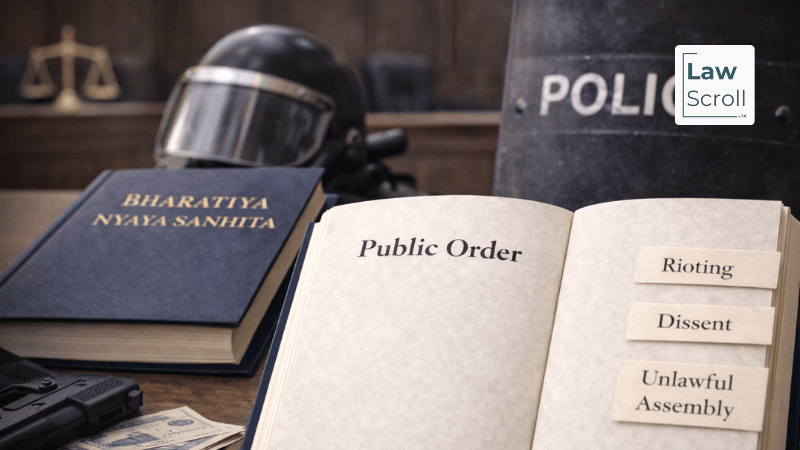
Public order occupies a delicate space in constitutional democracies. It lies at the intersection of individual liberty and collective security, of dissent and disorder, of expression and enforcement. Criminal law intervenes in this space not to suppress disagreement, but to prevent disruption that threatens the ordinary life of society. The Bharatiya Nyaya Sanhita, 2023 (BNS), carries forward this delicate balance while redefining how the law understands unlawful activities affecting public order.
Unlike offences that harm specific individuals, public order offences are concerned with societal impact. They address conduct that disturbs public tranquillity, creates fear or panic, or undermines the authority of lawful institutions. The challenge for any criminal code lies in drawing a principled line between legitimate protest and punishable disorder. The BNS attempts to draw this line through statutory definition, mental element, and judicial oversight.
Public Order as a Legal Concept
The concept of public order has long occupied Indian constitutional and criminal jurisprudence. It is narrower than “law and order” but broader than individual security. In Dr. Ram Manohar Lohia v. State of Bihar, the Supreme Court famously explained that every breach of law does not necessarily lead to a disturbance of public order. Only those acts that affect the community at large, and not merely individuals, fall within its scope.
The BNS adopts this settled understanding. Public order offences are not defined by private disputes or isolated misconduct, but by conduct that has the potential public consequence of disturbing peace, tranquillity, or social stability. This distinction is central to ensuring that criminal law does not become an instrument for routine policing of personal behaviour.
Unlawful Activities under the BNS Framework
Unlawful activities under the BNS encompass conduct that threatens public peace, disrupts lawful assemblies, incites violence, or undermines the authority of the State. These provisions are not new in spirit; they draw from long-standing principles under the Indian Penal Code while being recalibrated to modern realities.
Sections dealing with unlawful assembly, rioting, affray, and related offences continue to recognise that collective conduct can have consequences far beyond individual intent. The law focuses on group behaviour, shared objectives, and the likelihood of violence or disturbance.
Crucially, the BNS maintains that mere presence in a group is not sufficient. Criminal liability arises only when there is participation coupled with a common object, and that object is unlawful or becomes unlawful through conduct.
Unlawful Assembly and Common Object
The idea of unlawful assembly rests on the principle that numbers magnify harm. When individuals act collectively with a shared unlawful purpose, the potential for disruption increases significantly.
Under the BNS, an assembly becomes unlawful when its common object falls within prohibited categories, such as committing an offence, resisting lawful authority, or disturbing public peace. What matters is not the legality of the initial gathering, but whether its object or conduct transforms it into an unlawful assembly.
The Supreme Court, in Masalti v. State of Uttar Pradesh, clarified that common object does not require prior planning or express agreement. It may be inferred from the conduct of the assembly, the nature of weapons carried, and the circumstances surrounding the incident. This principle continues to guide courts under the BNS.
Rioting and the Use of Force
Rioting represents an aggravated form of unlawful assembly. It occurs when force or violence is used by an unlawful assembly or by any member thereof in pursuit of the common object.
The BNS treats rioting seriously because violence in a collective setting poses a heightened risk to public order. The emphasis is not merely on the injury caused, but on the breakdown of public tranquillity that accompanies group violence.
Courts have consistently held that individual overt acts need not be proved against every accused in a rioting case. What must be shown is membership of the unlawful assembly and participation in furtherance of its common object. This doctrine, while powerful, is balanced by the requirement of clear proof of participation.
Promoting Enmity and Public Disharmony
Public order is also threatened not only by physical violence but by acts that sow hatred and disharmony between groups. The BNS continues to criminalise conduct that promotes enmity between different classes on grounds such as religion, race, language, or place of birth, when such conduct has the potential to disturb public tranquillity.
The Supreme Court has repeatedly emphasised that these provisions must be applied with caution. In Pravasi Bhalai Sangathan v. Union of India, the Court recognised the harm caused by hate speech while cautioning against vague or overbroad application that could chill free expression.
Under the BNS framework, the focus remains on intent and effect. The prosecution must establish that the act was done with the intention, or had the likely effect, of disturbing public order. Mere unpopular or offensive speech, without this nexus, does not suffice.
Distinguishing Dissent from Disorder
One of the most critical challenges in public order jurisprudence is distinguishing legitimate dissent from unlawful activity. Protest, criticism of government, and collective expression are constitutionally protected. Criminal law intervenes only when such activity crosses into violence, coercion, or serious disruption of public life.
The Supreme Court in Mazdoor Kisan Shakti Sangathan v. Union of India affirmed that peaceful protest is a fundamental democratic right, but it cannot be exercised in a manner that completely blocks public spaces or paralyses civic life. The BNS provisions must be read in light of this balance.
The presence of slogans, assemblies, or demonstrations does not automatically trigger criminal liability. The law looks to conduct, intent, and consequence, not mere expression of views.
Role of Intention and Knowledge
As with other criminal offences, public order offences under the BNS require a culpable mental state. The general principles of mens rea under the BNS governing intention and knowledge apply equally here.
Courts have consistently held that accidental or unintended disturbance does not attract criminal liability. The prosecution must show that the accused either intended to cause public disorder or knew that such disorder was a likely consequence of their actions.
This requirement acts as a safeguard against arbitrary prosecution, particularly in politically sensitive contexts.
Preventive Logic and Criminal Liability
Public order offences often operate at the preventive edge of criminal law. The objective is not merely to punish harm after it occurs, but to prevent escalation into violence or widespread disorder.
However, preventive logic does not dilute the standard of proof. Criminal liability under the BNS continues to rest on proof beyond reasonable doubt. Courts have cautioned against using public order provisions as a substitute for preventive detention or administrative control.
Electronic Media, Speech, and Public Order
In the digital age, public order is no longer confined to physical spaces. Online speech, social media mobilisation, and digital misinformation can rapidly translate into real-world disorder.
While the BNS itself addresses substantive criminal liability, courts have increasingly examined how digital conduct intersects with public order. Messages that incite violence, promote hatred, or call for unlawful assemblies may attract liability if they meet the statutory thresholds of intent and impact.
At the same time, courts have warned against equating criticism or dissent expressed online with public order offences. The constitutional commitment to free speech applies equally in digital spaces.
Judicial Oversight and Procedural Safeguards
Given the potential for misuse, public order offences have always attracted close judicial scrutiny. Courts play a crucial role in ensuring that these provisions are not applied mechanically or selectively.
In State of Karnataka v. Praveen Bhai Thogadia, the Supreme Court emphasised that restrictions on speech or assembly must have a clear and proximate nexus with public order. Remote or speculative threats do not justify criminal prosecution.
The BNS framework, read with constitutional jurisprudence, reinforces the need for proportionality, necessity, and reasoned application.
Public Order, Policing, and the Citizen
For the ordinary citizen, public order law is often the most visible face of criminal law. It governs how assemblies are regulated, how protests are policed, and how collective behaviour is judged.
The BNS does not seek to criminalise civic life. Its provisions are designed to intervene only when conduct crosses the threshold from expression to disruption, from protest to coercion, from disagreement to disorder.
Understanding this distinction is essential to preserving both liberty and order.
Conclusion: Drawing the Line with Law
Public order law tests the maturity of a constitutional democracy. Too little regulation invites chaos; too much invites authoritarianism. The Bharatiya Nyaya Sanhita attempts to walk this narrow path by grounding public order offences in defined conduct, culpable mental states, and judicial oversight.
Ultimately, the strength of these provisions lies not in their breadth, but in their restraint. In a democracy governed by the rule of law, public order is protected not by silencing voices, but by ensuring that disagreement does not descend into violence. The BNS, if applied with constitutional fidelity, has the potential to uphold this balance.


