
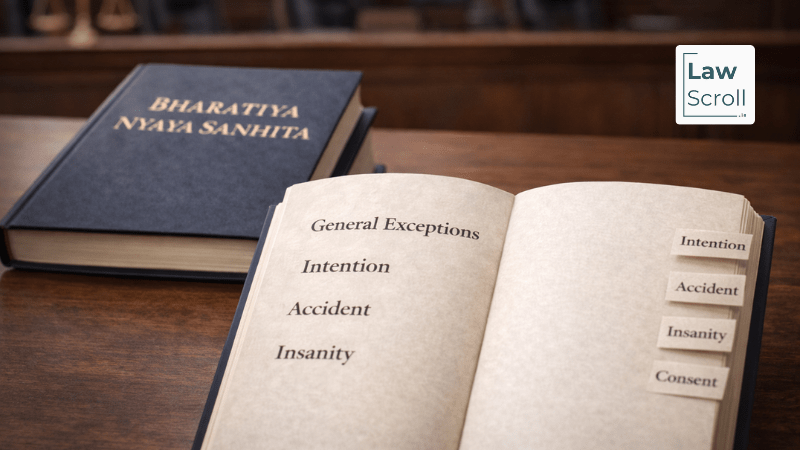
Criminal law does not punish every harmful outcome. It punishes only blameworthy conduct. This distinction lies at the core of the doctrine of general exceptions, which carve out situations where an act may technically fall within the definition of an offence, yet does not attract criminal liability.
The Bharatiya Nyaya Sanhita (BNS) consciously places general exceptions early in its scheme. This placement is not accidental. It signals that criminal law is as much about limiting State power as it is about defining offences. General exceptions operate as statutory safeguards, ensuring that punishment is imposed only where guilt, intention, and responsibility truly exist.
Understanding these exceptions is essential to understanding how Indian criminal law balances legality with justice.
Statutory Basis of General Exceptions under the BNS
The general exceptions under the BNS are contained in its early chapters and apply to all offences unless a specific provision states otherwise. This reflects a settled principle of criminal law: exceptions are of general application, cutting across individual offences.
These provisions are rooted in long-standing jurisprudence and constitutional values, particularly Articles 14 and 21. They embody the idea that criminal liability must be fair, rational, and humane.
Courts have consistently held that once an accused brings their case within a general exception, criminal liability stands excluded, even if the act satisfies all ingredients of the offence.
Burden of Proof and the Role of Exceptions
A distinctive feature of general exceptions is the allocation of the burden of proof. While the prosecution must prove the offence beyond reasonable doubt, the accused is only required to establish the applicability of a general exception on the standard of preponderance of probabilities.
This principle was clearly articulated in Dahyabhai Chhaganbhai Thakkar v. State of Gujarat, where the Supreme Court held that an accused need not prove an exception beyond reasonable doubt; it is sufficient if the court believes the exception may reasonably apply.
This calibrated burden reflects the presumption of innocence and ensures that exceptions remain meaningful safeguards rather than illusory defences.
Intention and Knowledge: The Mental Foundation of Liability
Criminal liability under the BNS is closely tied to the mental state of the accused. Intention and knowledge form the backbone of most serious offences. However, the absence of intention can radically alter liability.
Where an act is done without intention or knowledge of likely harm, criminal culpability may be reduced or excluded, depending on the offence. This distinction explains why causing death intentionally is treated differently from causing death negligently.
In State of Maharashtra v. Mohd. Yakub, the Supreme Court observed that intention is inferred from conduct, surrounding circumstances, and the natural consequences of the act. The BNS builds on this judicial understanding by carefully differentiating offences based on mental states.
Accident and Misfortune
One of the most humane general exceptions recognises that accidents happen. The BNS excludes criminal liability for acts done by accident or misfortune, provided they are done without criminal intention or knowledge, in a lawful manner, and with proper care and caution.
This exception reflects the principle that criminal law does not punish pure chance. If harm results from a lawful act carried out with due care, the law does not step in with punishment.
The Supreme Court in State of Rajasthan v. Keshavlal underscored that the absence of negligence is critical. An accident caused by recklessness or lack of caution does not fall within this exception.
This distinction ensures that the exception protects genuine accidents while preserving accountability for careless conduct.
Insanity and Mental Incapacity
Perhaps the most well-known general exception relates to insanity. The BNS continues the traditional rule that a person who, at the time of the act, was incapable of understanding the nature of the act or that it was wrong or contrary to law, is not criminally liable.
This exception is not based on sympathy but on logic. Criminal punishment presupposes the capacity to understand and choose. Where that capacity is absent, punishment loses its moral justification.
In Dahyabhai Chhaganbhai Thakkar, the Supreme Court clarified that the crucial point of time for assessing insanity is the moment of commission of the act, not before or after. Medical history may be relevant, but legal insanity is distinct from medical insanity.
The courts have applied this exception cautiously, balancing compassion with the need to prevent misuse.
Consent as a Defence
Consent plays a limited but important role in criminal law. Under the BNS, consent may exclude criminal liability where harm is caused with the free and voluntary consent of the person harmed, provided the act is not intended or known to cause death or grievous hurt.
This exception reflects respect for individual autonomy. Certain acts, such as sports injuries or medical procedures, inherently involve risk. Criminal law does not intervene where informed consent is present and the conduct is lawful.
However, consent obtained through fear, misconception, or coercion is no consent in law. The Supreme Court, in State of Karnataka v. Krishnappa, emphasised that consent must be an act of reason accompanied by deliberation.
The BNS carefully limits this exception to prevent exploitation, especially in cases involving vulnerable persons.
Acts Done in Good Faith
Good faith forms the backbone of several general exceptions. Acts done in good faith for lawful purposes, without malice or intent to cause harm, may be exempt from criminal liability.
This is particularly relevant for public servants and professionals who must make decisions that carry inherent risk. The law recognises that fear of prosecution should not paralyse lawful action.
In Ramesh Kumar v. State of Chhattisgarh, the Supreme Court observed that good faith requires due care and attention. Mere belief is not enough; the conduct must meet an objective standard of reasonableness.
Necessity and Lesser Harm
The doctrine of necessity recognises that sometimes harm is unavoidable to prevent a greater harm. Where an act is done to prevent a more serious injury, and the harm caused is proportionate, criminal liability may be excluded.
This principle reflects the maxim necessitas non habet legem — necessity knows no law — tempered by judicial restraint. Courts have consistently held that necessity cannot justify disproportionate or avoidable harm.
The BNS incorporates this doctrine to ensure that the law does not punish conduct compelled by extraordinary circumstances.
Private Defence and Limits of Protection
The right of private defence, though often discussed separately, operates as a general exception. It allows individuals to protect their body or property against unlawful aggression, subject to proportionality.
The Supreme Court, in Darshan Singh v. State of Punjab, clarified that the right of private defence is preventive, not punitive. It exists only so long as the threat persists and does not extend to acts of retaliation.
The BNS retains this carefully balanced framework, ensuring protection without encouraging vigilantism.
General Exceptions and Judicial Interpretation
General exceptions under the BNS are not rigid rules but living doctrines shaped by judicial interpretation. Courts examine the totality of circumstances, evidence, and conduct of the accused before applying an exception.
The consistent judicial approach has been to interpret exceptions liberally where justice demands, but strictly where misuse is apparent. This balance preserves both individual rights and societal interests.
Why General Exceptions Matter
General exceptions perform a constitutional function. They prevent criminal law from becoming oppressive and ensure that punishment is reserved for truly blameworthy conduct.
For citizens, these exceptions act as shields against arbitrary prosecution. For courts, they provide the tools to do substantive justice beyond mechanical application of offences.
Conclusion
The general exceptions under the Bharatiya Nyaya Sanhita are not loopholes. They are deliberate legislative choices reflecting centuries of criminal law wisdom. By recognising intention, accident, insanity, consent, good faith, and necessity, the BNS affirms that criminal law is a moral enterprise governed by reason, fairness, and humanity.
Understanding these exceptions is essential to understanding criminal liability itself. They remind us that in the administration of criminal justice, law must always be tempered with justice.


