
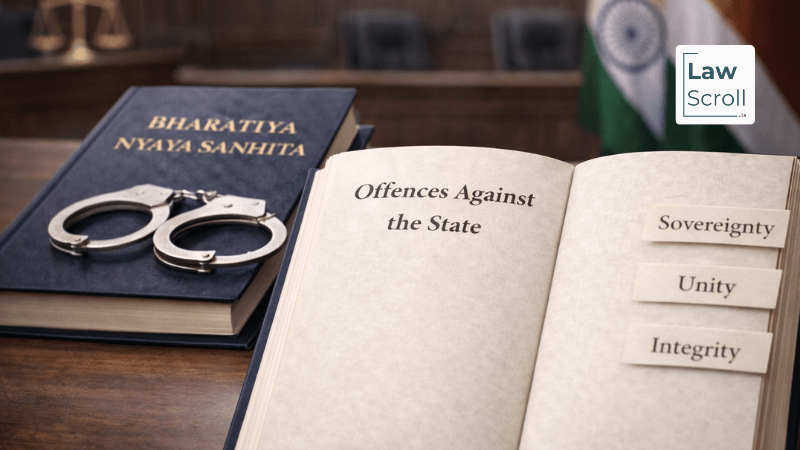
Every criminal code reflects what a society considers most vital for its survival. In any nation-state, the gravest threat is not merely violence between individuals but acts that strike at the authority, stability, and territorial integrity of the State itself. The Bharatiya Nyaya Sanhita (BNS), like the Indian Penal Code before it, accords special seriousness to offences against the State, but it does so with updated language, refined classifications, and a conscious attempt to balance national security with constitutional freedoms.
Offences against the sovereignty, unity, and integrity of India occupy a foundational place in the BNS. These provisions are not about suppressing dissent or silencing criticism; they are about protecting the constitutional order from armed rebellion, violent subversion, and organised attempts to fracture the nation. Understanding these offences is essential, especially in a constitutional democracy where the line between lawful protest and criminal conduct must be carefully drawn.
At the outset, it is important to note that the BNS deliberately moves away from colonial-era terminology. Concepts such as “sedition”, which generated extensive constitutional debate, have been replaced with provisions that focus more precisely on violent and subversive conduct. This shift reflects judicial developments, constitutional values, and the realities of modern threats to national security.
The core provisions dealing with offences against the State are found in the early chapters of the BNS, dealing with acts that endanger sovereignty, unity, and integrity, wage war against the Government of India, or incite armed rebellion.
One of the most serious offences recognised under the BNS is waging war against the Government of India. The offence is defined broadly to include not only actual armed conflict but also attempts, abetment, and conspiracy to wage such war. The emphasis here is on organised violence aimed at overthrowing or undermining the authority of the State.
Judicial interpretation has consistently clarified that “waging war” does not mean conventional warfare alone. In Navjot Sandhu v. State (Parliament Attack case), the Supreme Court observed that war against the State may take many forms, including coordinated terrorist attacks intended to destabilise governance and instil fear. What matters is the intention to challenge the sovereignty of the nation through violence.
Punishment for waging war or attempting to wage war under the BNS remains among the harshest, reflecting the gravity of the offence. Life imprisonment or the death penalty may be imposed, depending on the nature and consequences of the act. This aligns with the constitutional principle that the State has the right to protect itself against existential threats.
Closely related to waging war are offences involving conspiracy to wage war. Even where violence has not yet occurred, the mere agreement and preparation to wage war, if proved, attracts severe punishment. This reflects the preventive philosophy of criminal law when dealing with threats to national security. As held in Kehar Singh v. State (Delhi Administration), conspiracy to commit serious offences against the State is often clandestine, and courts may rely on circumstantial evidence, provided it establishes a clear meeting of minds.
Another significant category under the BNS concerns acts endangering the sovereignty, unity, and integrity of India. These provisions address conduct that may not amount to open warfare but nevertheless seeks to dismember the nation, incite secession, or promote armed rebellion against the constitutional order.
The legislative intent here is crucial. Mere expression of opinion, academic discussion, or political advocacy does not fall within the ambit of these offences unless it is accompanied by incitement to violence or armed action. This distinction has constitutional roots in Article 19 of the Constitution, which protects freedom of speech while permitting reasonable restrictions in the interests of sovereignty and public order.
The Supreme Court’s jurisprudence, particularly in Kedar Nath Singh v. State of Bihar, remains relevant even under the new statutory framework. The Court held that only speech or expression that incites violence or has the tendency to create public disorder can be criminalised. The BNS, by focusing on violent and subversive acts rather than vague disaffection, seeks to align statutory law with this constitutional standard.
Terrorism and acts of organised violence aimed at destabilising the State are also addressed under the BNS, often in coordination with special laws. While specialised legislation like the Unlawful Activities (Prevention) Act continues to operate, the BNS provides the foundational criminal law framework for acts that threaten national security.
Offences such as aiding armed groups, providing shelter or resources to insurgents, or facilitating terrorist activities are treated as serious crimes against the State. The doctrine of abetment plays a crucial role here. Even indirect assistance, if provided with knowledge of the unlawful objective, attracts criminal liability.
In State of Maharashtra v. Mohd. Yakub, the Supreme Court emphasised that intention and knowledge are central to such offences. The prosecution must establish that the accused was aware of the nature of the activities being supported and consciously contributed to them.
Another important aspect of offences against the State is the criminalisation of acts that undermine the authority of the armed forces. Mutiny, abetment of mutiny, or attempts to seduce armed forces personnel from their duty are treated with utmost seriousness. The rationale is evident: discipline and loyalty of the armed forces are indispensable to national security.
At the same time, courts have insisted on strict proof in such cases. Casual criticism of the armed forces or exposure of wrongdoing does not amount to an offence unless it is accompanied by intent to incite disobedience or rebellion.
The BNS also addresses offences relating to unlawful assemblies and public disorder when such assemblies have the object of challenging the authority of the State through violence. While peaceful protest remains a constitutional right, assemblies that carry arms, resort to violence, or seek to overawe the government by criminal force cross into the realm of criminality.
In Ramlila Maidan Incident v. Home Secretary, Union of India, the Supreme Court reaffirmed that the right to protest is subject to public order considerations. The BNS reflects this balance by criminalising violent assemblies while leaving room for lawful dissent.
One of the most significant and debated changes introduced alongside the BNS regime is the removal of the offence of sedition as it existed under Section 124A of the IPC. Instead of a broadly worded provision criminalising disaffection, the BNS focuses on concrete acts such as inciting armed rebellion, secessionist violence, or subversive activities threatening national integrity.
This shift is not merely semantic. It reflects decades of judicial caution against misuse of sedition laws. The Supreme Court, in multiple interim orders, has emphasised the need to prevent the chilling of free speech. The BNS attempts to codify this judicial wisdom by narrowing the scope of criminalisation.
From an evidentiary standpoint, offences against the State demand a higher degree of scrutiny. Given the severity of punishment and the potential for misuse, courts insist on credible, cogent evidence. Confessions, electronic evidence, intercepted communications, and witness testimony are all evaluated with care.
The Bharatiya Sakshya Adhiniyam plays a critical role here, particularly in relation to electronic evidence and presumptions. Digital communications, financial trails, and online propaganda often form the backbone of prosecutions in modern offences against the State. Courts have recognised that while technology expands investigative capacity, it also requires safeguards to prevent fabrication and misuse.
The constitutional dimension of these offences cannot be overstated. Article 21 guarantees personal liberty, and any law curtailing it must satisfy the test of fairness, reasonableness, and due process. The BNS provisions, read in light of constitutional jurisprudence, are intended to operate within these limits.
The principle of proportionality is particularly relevant. Not every unlawful act against the State warrants the harshest punishment. The degree of violence, intent, and actual impact are all relevant factors in sentencing. Courts have repeatedly held that punishment must be commensurate with culpability, even in cases involving national security.
Ultimately, offences against the State under the Bharatiya Nyaya Sanhita reflect a conscious effort to modernise criminal law without compromising constitutional values. By focusing on violence, armed rebellion, and organised subversion, the law seeks to protect sovereignty and unity while respecting democratic freedoms.
For the ordinary citizen, these provisions may seem distant, but they form the legal backbone of national security. For the legal community, they demand careful interpretation, rigorous evidence, and constant constitutional vigilance. The strength of a democracy lies not only in its ability to defend itself but also in its restraint while doing so.


