
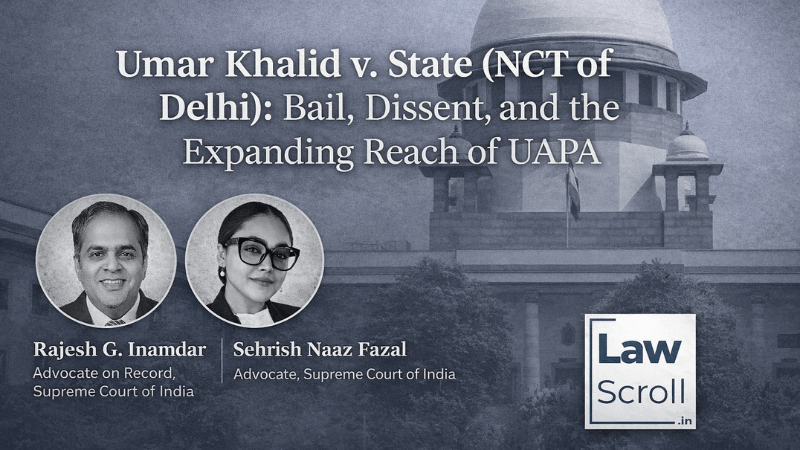
The Supreme Court’s refusal of bail to Umar Khalid and Sharjeel Imam under the Unlawful Activities (Prevention) Act, 1967 (UAPA) in the 2020 Delhi riots “larger conspiracy” case marks a defining moment in bail jurisprudence. Yet the constitutional implications of this order extend beyond statutory interpretation and demand careful reflection on the relationship between liberty, dignity, equality, and state power. This article examines the judgment in the context of established bail doctrine, the evolving scope of UAPA as interpreted by courts, and broader concerns about judicial consistency, refusal to follow precedent on delay, and the risk that ordinary protest or dissent could be recast as terrorism, with consequent impacts on fundamental rights.
On 5.01.2026, a Supreme Court Bench of Justices Aravind Kumar and N.V. Anjaria in Umar Khalid v. State (NCT of Delhi) and connected matters, 2026 INSC 2, considered bail applications arising out of the alleged “larger conspiracy” behind the February 2020 northeast Delhi riots.
The Court granted bail to five co accused namely Gulfisha Fatima, Meeran Haider, Shifa Ur Rehman, Mohd Saleem Khan and Shadab Ahemd subject to the conditions in the bail order holding that the material placed on record against them disclosed, at the highest, a peripheral or limited role, did not prima facie establish their involvement in acts amounting to terrorism, and that their prolonged pre-trial incarceration weighed in favour of liberty.
In contrast, the Court declined bail to Umar Khalid and Sharjeel Imam, holding that the prosecution material prima facie satisfied the statutory threshold under Section 43D(5) of the Unlawful Activities Prevention Act, 1967. The Bench accepted the prosecution’s case that Khalid and Imam occupied central and directive roles in the alleged conspiracy, relying substantially on speech excerpts, digital communications, and alleged coordination and mobilisation efforts, and concluded that they stood on a qualitatively different footing from the other accused. On this basis, the Court held that the statutory embargo on bail was attracted at this stage, notwithstanding the period of incarceration already undergone.
Although the Court acknowledged that prolonged incarceration and delay in trial are relevant under Article 21 it held that such delay does not automatically override statutory bail restrictions. The accused were permitted to renew their bail pleas only after examination of protected witnesses or after one year, whichever was earlier.
This ruling foregrounds a constitutional dilemma how are courts to harmonise parliamentary bail restrictions with fundamental guarantees of liberty and equality especially where detention precedes trial by several years.
This refusal has drawn widespread commentary, but it ultimately foregrounds a constitutional challenge: how to align constitutional guarantees of personal liberty and equality with parliamentary bail conditions enacted in the context of national security and public order.
Beyond the surface legal reasoning, the case raises fundamental questions about the reach of anti-terror laws, judicial interpretation of terrorism, and how constitutional rights are balanced against claims of national security.
Under Article 21, personal liberty cannot be deprived save by “procedure established by law” that is fair, just, and reasonable. The Supreme Court has long held that “bail is the rule and jail the exception”, emphasising that the right to liberty is the norm in pre-trial contexts.
Section 43D(5) of the UAPA imposes a high bar for bail by requiring courts to be satisfied that the prima facie accusations are not true. However, constitutional jurisprudence, including in NIA v. Zahoor Ahmad Shah Watali and Union of India v. K.A. Najeeb, recognises that prolonged pre-trial incarceration and delay can cumulatively produce conditions that violate Articles 14 and 21, even under special statutes.
Section 15 of the UAPA defines a “terrorist act” by coupling terror-centric intent with the use of exceptional means such as explosives, firearms, or methods likely to cause death, destruction, or widespread disruption. A plain reading suggests that ordinary criminal violence or protest actions should fall outside the core ambit of terrorism. However, judicial interpretations have progressively expanded the statutory reach.
In Vernon Gonsalves v. The State of Maharashtra, 2023 SCC OnLine SC 885, the Courts have granted bail where no recovery of arms, funds, or direct involvement is shown. The material in possession should attract UAPA offences, and not merely the labelling. It has been held that such statutory restrictions, per se, do not oust the jurisdiction of the Constitutional Courts to grant bail on grounds of violation of Part III of the Constitution of India and it would be within the jurisdiction of the Constitutional Courts, i.e., this Court and the High Courts to relax the rigours of such provisions,
In the cases of Bhima Koregaon and the Delhi riots, many accused spent five years or more in custody without bail, even though the evidence did not directly link them to the use of terror-producing means. Critics have observed that in both cases, despite prolonged detentions under UAPA, no overt acts involving explosives, bombs, or firearms were attributed to the accused; primarily, electronic evidence and communications were relied upon.
This expansive invocation of UAPA’s terrorism provisions arguably transforms ordinary riot-related or protest-linked conduct into terrorism by treating unconnected messages or digital communications as sufficient to establish prima facie guilt under Section 43D(5). Such a trend, if unchecked, could allow broad criminal statutes to engulf acts of dissent or political expression that have no clear causal link to violence.
Dissent, Crime, and the Threshold of Criminality
The denial of bail to Khalid and Imam rested heavily on allegations that they were “central” to an alleged conspiracy involving planning, mobilisation, and strategic leadership, as reflected in speech excerpts and other prosecution material
Critics have called it a “travesty of justice” condemning how the judicial system has let them down. Where leading the socio-political movements and participating in the noise and democracy which are the true virtues of the Gandhian principles are called crimes, this charade is as much a part of the constitution, as the imprisonment itself is.
The Supreme Court also lends its weight to the claim that Khalid and Imam played a “central and formative” role while others had “merely conspiratorial association”. It is troubling that the Court does this not on the strength of the evidence it examined but on the flimsy narrative of the prosecution. At several points, the Court reminded itself that a bail application is not the stage for a “min-trial”. However, in categorising the accused and examining the depth of the roles, the Court effectively does the job of a trial court and gives the prosecution the benefit of the doubt.
A constitutional democracy draws a sharp distinction between protected dissent and criminal conduct. In Kedar Nath Singh v. State of Bihar, sedition was confined to speech that incites violence. Similarly, in Shreya Singhal v. Union of India, the Supreme Court reaffirmed that advocacy, even if provocative, remains protected unless it incites imminent lawless action.
The Delhi High Court In Disha Ravi v. State, , similarly recognised that expression of dissent cannot be equated with criminality without a clear link to unlawful acts, a principle that informs bail analysis when detention follows speech-centric allegations.
Yet in the Khalid–Imam bail order, elements of political protest, speech, and communication are treated, in the prosecution’s narrative, as indicators of a larger terrorist conspiracy. While courts have authority to assess prima facie material, the absence of a clear definition of terrorism combined with expansive application risks blurring constitutional guarantees with broadly framed state interests.
Delay in Trial, Precedent, and Judicial Discipline
Past constitutional decisions have emphasised that delay in trial and prolonged detention, without commensurate progress in the case, can justify bail even under stringent statutes. In Najeeb, the Supreme Court held that delay could operate as a ground for bail; judicial refusal to acknowledge this principle in subsequent orders can signal a concerning departure from established precedent.
Two recent decisions Javed Gulam Nabi Shaikh v. State of Maharashtra and Sheikh Javed Iqbal v. State of Uttar Pradesh, explicitly affirmed that constitutional protections under Article 21 apply irrespective of the seriousness of the offence when the State fails to ensure a speedy trial. Yet in the Khalid–Imam order, these precedents were distinguished rather than engaged with directly, raising questions about judicial discipline in consistently applying constitutional norms.
While this order was passed, a co-ordinate Bench of the Supreme Court, albeit in proceedings under the PMLA, delivered a completely diametrical judgment. In Arvind Dham v. Directorate of Enforcement, 2026 INSC 12 (decided on 6 January 2026), the Court held that prolonged pre-trial incarceration, in the absence of meaningful progress of trial, impermissibly converts detention into punishment and violates Article 21, notwithstanding the rigours of a special statute. The Bench emphatically ruled that the right to a speedy trial is not eclipsed by the gravity of allegations. The coexistence of these sharply divergent approaches by co-ordinate Benches, one prioritising constitutional liberty and the other sustaining prolonged incarceration under similarly stringent statutory regimes results in diametrically opposite outcomes on the same foundational principles. Such inconsistency erodes predictability in bail jurisprudence, implicates Article 14, and calls for doctrinal clarity to prevent the discretionary exercise of bail jurisdiction from becoming uncertain or arbitrary.
Selective Prosecution and Equality Before Law
A constitutional concern arises from the uneven application of criminal law in relation to the 2020 Delhi riots, where publicly available records indicate that certain politically influential actors, whose speeches were alleged to have contributed to the violence, were either not prosecuted or not subjected to custodial detention, while stringent provisions of the UAPA were invoked primarily against student activists and dissenting voices on allegations centred on speech and association. Such differential enforcement engages Article 14, as arbitrariness in State action is antithetical to equality before law (E.P. Royappa v. State of Tamil Nadu, (1974) 4 SCC 3). Although non-prosecution of one accused does not confer a right to bail upon another, selective and discriminatory invocation of penal statutes undermines the neutrality of criminal process. Prolonged pre-trial incarceration in such circumstances risks assuming a punitive character, impermissible under Article 21 (Sanjay Chandra v. CBI, (2012) 1 SCC 40). The Supreme Court has further clarified that even under special statutes, liberty cannot be indefinitely curtailed where continued detention becomes disproportionate (Union of India v. K.A. Najeeb, (2021) 3 SCC 713). Such asymmetry, if left unaddressed, erodes confidence in the rule of law and the institutional legitimacy of prosecution.
Comparative Jurisprudence on Speech, Security, and Bail
United States
In Brandenburg v. Ohio, the U.S. Supreme Court held that speech may only be punished when it is directed to and likely to incite imminent lawless action — a high threshold protecting political expression.
United Kingdom / European Court of Human Rights
Under the Terrorism Act 2000, courts apply strict necessity and proportionality tests for detention, subject to review under Article 5 ECHR. In Selahattin Demirtaş v. Turkey (No. 2) (2020), the ECHR held that prolonged detention of political dissenters was incompatible with democratic pluralism.
These standards underscore that, even in national security contexts, liberty interests require robust protection.
Conclusion
The Supreme Court’s January 2026 bail order illustrates the tension between statutory bail restrictions and constitutional liberties. While courts must respect legislative frameworks, they must also remain vigilant against interpretations that erode the presumption of innocence, equate dissent with terrorism, or weaken protections against prolonged pre-trial detention.
As the judiciary interprets and applies UAPA, it must do so with a keen appreciation of constitutional safeguards, ensuring that criminal justice does not become a surrogate for punishment without conviction and that ordinary dissent is not swept into the net of terrorism law merely because it presents political discomfort. Upholding the rule of law demands not only substantive justice but adherence to discipline in applying long-standing constitutional precedents.
Dr. B.R. Ambedkar’s famous slogan, “Educate, Agitate, Organize!” describes precisely that constitutional rights are meaningful only when citizens are aware, united and assertive. Under the logic of this judgment, it also describes the pathway to jail.
What a terrible, terrible day for democracy!
Disclaimer:
Mr. Rajesh G. Inamdar, Advocate on Record, Supreme Court of India and Ms Sehrish Naaz Fazal Advocate, Supreme Court of India. The views expressed are personal and academic, intended to contribute to constitutional discourse on bail jurisprudence. They do not reflect the views of any court, institution, or client, and should not be construed as legal advice or as expressing any opinion on the merits of any matter.


