
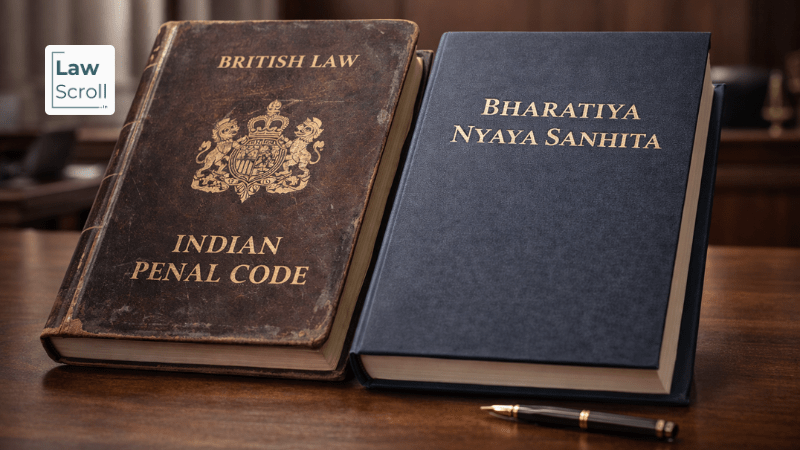
When India replaced the Indian Penal Code with the Bharatiya Nyaya Sanhita in July 2024, the change was often described in technical terms — new sections, reworded offences, revised punishments. What received less attention was the deeper question the new law raises: what is criminal law meant to do in a constitutional democracy?
The IPC, drafted in the mid-19th century, answered that question very differently. It was designed for governance, not justice; for control, not rights; for certainty, not proportionality. Its survival after Independence was a matter of necessity rather than choice. Courts softened its edges, read constitutional values into its provisions, and struck down the worst excesses. But the underlying philosophy remained colonial.
The Bharatiya Nyaya Sanhita marks an attempt — cautious, incomplete, but deliberate — to realign criminal law with constitutional first principles.
The Indian Penal Code was never neutral. Drafted under the supervision of Thomas Babington Macaulay, it reflected the anxieties of an imperial administration governing a vast and restive population. Order was prioritised over liberty. Obedience mattered more than consent. Crimes against the State were placed at the centre of the Code, not because they were the most harmful to society, but because they were the most threatening to colonial authority.
The architecture of the IPC made this clear. Sedition, waging war, unlawful assemblies, and public disorder were framed broadly, leaving wide discretion with the executive. Punishment was conceived primarily as deterrence. Imprisonment was the norm, severity a feature, and rehabilitation an afterthought.
Independent India inherited this structure in 1950, but adopted a Constitution that rejected its assumptions. Fundamental rights under Articles 14, 19, and 21 placed liberty, equality, and dignity at the heart of the legal order. Criminal law, however, remained frozen in time. The task of reconciling a colonial statute with a constitutional charter fell almost entirely on the judiciary.
Over decades, courts attempted that reconciliation. Sedition was read down to apply only to speech inciting violence. Criminal defamation was restrained through judicial caution. Adultery was struck down as unconstitutional. Privacy was read into Article 21 and used to reshape police powers. These were necessary interventions — but they were also corrective. The law itself did not change; its application did.
The Bharatiya Nyaya Sanhita represents a shift in where that corrective burden lies.
Rather than relying entirely on judicial interpretation, the BNS attempts to rewrite criminal law in language more attuned to constitutional governance. Its stated objective is not merely to punish wrongdoing, but to do so in a manner consistent with dignity, proportionality, and social context. This is visible not only in what the law includes, but also in what it removes and reorders.
The most symbolically significant removal is sedition. Section 124A of the IPC had long been a constitutional anomaly — repeatedly criticised, frequently misused, and sustained largely through judicial restraint rather than legislative confidence. Its deletion from the BNS is not a declaration that the State has relinquished its interest in security. Instead, it reflects a philosophical recalibration: the State is protected not from dissent, but from genuine threats to sovereignty and integrity.
The new offence addressing acts endangering national unity shifts attention away from political disaffection and towards demonstrable harm. This distinction matters in a constitutional democracy, where disagreement with authority is not a crime, but a democratic right.
Another philosophical departure lies in how punishment is conceived. The IPC treated imprisonment as the default response to criminality. The BNS, for the first time, statutorily recognises community service as a form of punishment for certain offences. This is not leniency by design; it is proportionality in practice.
By acknowledging that not every offence warrants incarceration, the law reflects an understanding that punishment serves multiple purposes — deterrence, reformation, and social repair. This aligns more closely with constitutional jurisprudence that has long emphasised dignity even in punishment, particularly under Article 21.
The BNS also reflects a shift in how criminal responsibility is framed. While core concepts like intention and knowledge remain intact, the law pays closer attention to context — organised crime, collective violence, technological offences, and crimes that disproportionately affect vulnerable groups. This does not signal a softer State. In many respects, the BNS is stricter. But the strictness is targeted, not indiscriminate.
Crimes against women and children are placed more prominently, with clearer definitions and firmer sentencing structures. Organised crime and terrorism are addressed directly within the criminal code rather than through scattered special statutes. This integration reflects a recognition that contemporary criminal threats cannot be treated as exceptional disruptions; they are part of the legal landscape.
What the BNS does not do is dismantle State power. The police remain powerful. Arrest and prosecution remain coercive. The criminal justice system is still adversarial and punitive in many respects. The philosophical shift is therefore not revolutionary. It is evolutionary — moving away from colonial suspicion of the citizen and towards constitutional accountability of authority.
Critics often argue that the BNS merely repackages the IPC with Indian nomenclature. That critique underestimates the importance of statutory philosophy. Laws shape institutional behaviour not only through enforcement, but through the values they signal. A criminal code that speaks in constitutional terms invites constitutional interpretation. One that speaks in colonial terms resists it.
Whether the BNS fulfils its philosophical promise will depend on how it is applied. Police training, prosecutorial discretion, and judicial interpretation will determine whether the shift from control to justice is real or rhetorical. The text alone cannot transform practice.
But the act of rewriting matters.
For the first time since Independence, India has consciously attempted to align its principal criminal statute with the constitutional vision adopted in 1950. The BNS does not perfect that alignment. It does, however, acknowledge the tension — and that acknowledgement itself marks a departure from the colonial past.
Criminal law in a democracy must do more than punish. It must justify punishment. It must explain why the State intervenes, how far it may go, and where it must stop. The IPC answered those questions in the language of empire. The Bharatiya Nyaya Sanhita attempts to answer them in the language of a Republic.
Whether it succeeds will be judged not by its title, but by how faithfully constitutional justice replaces colonial control in everyday practice.


